
Home › Forums › Jake Thackray Only › Jake’s Music › Thackray in Russian – I need the score
- This topic has 76 replies, 7 voices, and was last updated 11 years, 5 months ago by
 Dmitry.

-
AuthorPosts
-
3 November 2014 at 11:22 pm #6375
Hi, Dmitri.
I think you’re right – I’m a lot more familiar with the song now, than I was when I posted the tab document several years ago, and your correction seems to fit my understanding of the song. There may have been an original transcription error in the tab when it was sent to me, or when I actually copied it and posted it. I’ll have it corrected for you – thanks for pointing it out !
Malcy
8 November 2014 at 5:19 pm #6382Hi Dmitry,
I can put the melodies (at least the first verse) down as a score for you using Sibelius software – I just need time to be able to sit down and do it! If you search the lyrics and chords you will see a version of ‘Joseph’ I did scored for piano. Is something like that any good?
If you let me know your song priority, I could make a start soon.
Phil9 November 2014 at 9:20 am #6391Hi, Malcy !
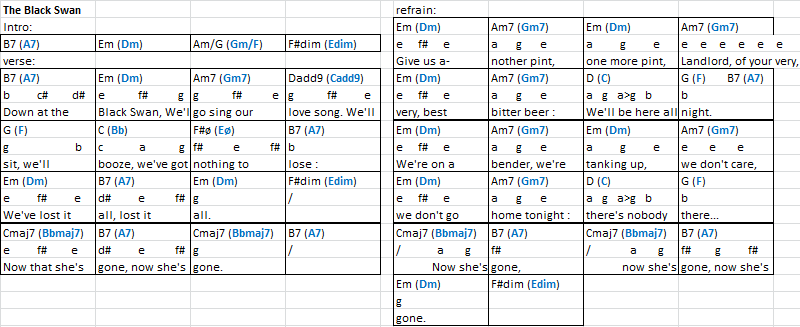
I sang The Black Swan already with “your” correct notes. (The only thing, in my opinion you were mistaken in one note:
E F# E A G E A G D E E E — «We’re on a bender, we’re tanking up, we don’t care»
(There is E. No?)
At the same time I made other “logical” accord harmony with a full circle of fifths. It for stupid musicians like me.
I began not with a tonic chord, but with the dominant. By the way, I started analyzing Ulysses. The melody at the beginning of verses almost similar (but 4/4) also begins with B7 Em.
If it is interesting to you, you can look at the version of chords in the attached drawing or the XL format https://yadi.sk/i/WU2Ttrdpcanxw. And you can listen according to my former link (I sang in the Dm tonality) http://www.chitalnya.ru/work/1167041/ .Hi, Phil !
Unfortunately, I didn’t find your version of ‘Joseph’
I am very glad that you responded to my request. My desirable songs (I already translated it) in the order of priority:On Again! On Again!
The Blacksmith and the ToffeeMaker
Lah-Di-Dah (The melody of each verse is unique here, but if you make only the first, you all the same strongly will help me.)
The Ballad of Billy Kershaw
Leopold Alcox
Ulysses (Probably, I will be able to make it.)Yours faithfully
D.Attachments:9 November 2014 at 3:21 pm #6392I’ll see what I can do, Dmitry.
here is the piano version of Joseph: http://www.jakethackray.co.uk/images/stories/pdf/joseph-piano.pdf11 November 2014 at 1:30 pm #6404Hello! I sang Ulysses in Russian so well as far as managed – http://www.chitalnya.ru/work/1176937/
In translation I made the unified rhythmic form for all verses and refrains (except the introduction and final line).
I changed harmony of a verse, especially in the third and fourth lines
(Em tonality):
Gdim
|B7 |Em Gdim| (I’ve got a dog called Ulysses)
|B7 |Em Em/G|
|Am6 |B7| (<|A |D | ) |Am6 |B7| (<|A |D Gmaj7 Amaj7|) |Gdim B7| (When my…) I changed the melody in final line a little. Chords D G > Dm Gm
I ask you to express opinion as you perceive this changed version.I couldn’t determine by ears what notes of Thakray sings in the anacrusises of the verses. It seemed to me these notes is different in different verses. I sang in my version Bb, Bb Bb, G, D# in four lines respectively.
Also it is unclear: who every time lets Ulysses in the house? In English houses there is a special not locked dog door?
Phil, I downloaded your notes, thanks! It is good professional work.
I didn’t translate this song but probably in the future I will make it.14 November 2014 at 5:54 am #6412[quote=”philreckless” post=3612]I can put the melodies (at least the first verse) down as a score for you using Sibelius software – I just need time to be able to sit down and do it! [/quote]
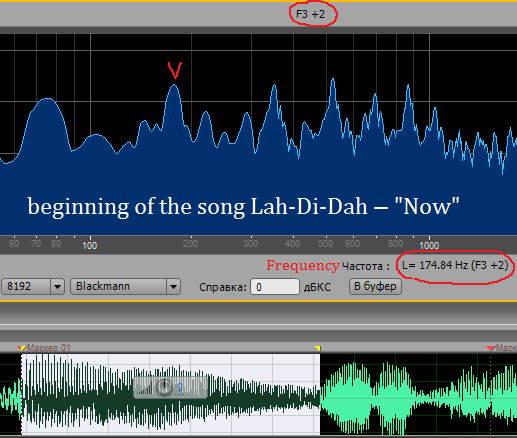
I tried to use the spectral analyzer for definition of notes of a melody. But it turns out badly because Thackray sometimes irregularly sings notes not in a tonality or it is inexact (between notes).
For example song Lah-Di-Dah. The chord preceding the beginning of singing is A7. It can be determined by a range precisely. The final chord too can be defined precisely. It is D. Therefore probably that Jake sings in the D tonality and begins with the D chord (here on the site the major C tonality is given). Therefore the first note (on the syllable “Now”), theoretically has to be F#, but Jake sings almost F note. It is possible to look at the attached drawing. The further spectral analysis of the line “Now we’re agreed that we’re in |love” yields result FF#F#FFFF|F (all notes inexact).
The spectral analysis of other lines too doesn’t allow to define to me: where there is an error of singing of Jake and where there is his idea.
Unfortunately, one stale program isn’t enough here. Nevertheless musical intuition and ears necessary.Attachments:14 November 2014 at 1:21 pm #6413Hi, all.
I think this kind of analysis has to end up incorporating a certain amount of guesswork and intuition, not just for Jake’s work but for every song you hear and want to work out. Part of the “artistry” of a song comes from the way it’s sung, the variations and emotions included in the performance by the vocalist in the using of their voice, which is a far complex and more variable instrument than any other that man has devised. A song which is sung to precisely the same tune for each verse and chorus, with complete accuracy of tone and no elision, acciaccaturas, glissandos, local accents etc would probably end up sounding rather dull and robotic.
So when working out a tune, you either have to tab or score the whole thing, including any changes, however small, between each repeated phrase, or you provide a “best guess” approximation averaged across several verses or choruses. This, you finally report, is probably the real tune to the verse, chorus and middle 8 : but the singer varies each verse slightly in different places, and it’s now up to the performer to put in as little, as many, or even their own different changes, in the course of their interpretation. It isn’t an exact science, it’s an art form, and reducing it to its components is like turning the Mona Lisa to a painting-by-numbers picture where large areas are simply shown as black, rather than the actual 287 shades of black, dark green, dark red and burnt umber. You can, indeed, scan a Jake song, as much as you could do with a painting, building or film, and say “this is how it’s made” but, really, the way you analyse something depends on what you want to do with the results. Do you want to catalogue the song ? Reproduce it ? Re-interpret it ? Or, in Dmitry’s case, translate it ?
A final point is that you also have to factor in the skills of the person using the results, the analysis data. Most people are not Leonardo Da Vinci, so they need a painting-by-numbers kit to come up with something that looks vaguely like the Mona Lisa : comparatively very few people have the brush skills and range of equipment to reproduce one with a high percentage success rate. Similarly, if you haven’t got the vocal range of Jake, or can’t “do” his accent and mannerisms, etc, then your singing of Lah-Di-Dah will lie on a sliding scale somewhere between Jake’s version and one that might have been done by Jedward*. How close you are to Jake’s or Jedward’s version depends on your personal vocal skill, your desire to get it to sound how you want, and the effort you’re prepared to put in learning and practising it. And that’s just singing it ! How do you do all the orchestral backing on Jake’s Lah-Di-Dah version from Last Will And Testament if you only have a single guitar or keyboard to achieve it ? Jake didn’t attempt it – his version on Last Performance is far more stripped down.
Dmitry has already said that he’s prepared to change or simplify some of the chords in his version of The Black Swan to make the song easier to render in Russian, and that’s a decision we all have to make to a greater or lesser degree when starting to learn a new song with the aim of playing it. But with every change or compromise you introduce, whether for convenience, taste, or even if you simply can’t sing it in F, or play it to the complexity you want with your good old chipolata-fingers, you make the song completely different from Jake’s original, and may have to make other changes to make it work, including changing the original tune to fit your new chords.
Look at the difference between Elton John’s “Your Song” and the one simplified by Ellie Goulding. They’re really not the same song at all, and it’s up to the listener’s taste to decide if one is watered-down, shortened and homogenised, or if the other is too fiddly, difficult and pompous. There is no definitive, correct answer – it’s all in the eye (ear) of the beholder. However… Me – I prefer the original, but I have never seen it performed live by anyone other than Elton John… until Ellie’s version became famous : and since then I have seen it played by a variety of lady and men folkies on a variety of instruments. Did making a simpler version make it more accessible ? Probably, but it all depends on where you stand.
Malcy
(* shudder)
14 November 2014 at 1:42 pm #6414Dmitry :
Also it is unclear: who every time lets Ulysses in the house? In English houses there is a special not locked dog door?
😆
Jake was writing this song in the 1960s, and possibly remembering with fondness the previous decade too. Everyone knows that in Blighty in the 50s and 60s, no-one locked their doors, because there was no crime, and neighbours and communities looked out for each other. In the universe “Ulysses” is set in, Jake leaves the back door open, in case the dog wants to come in, or his next-door neighbour wants to pop in for a cuppa.
Then came Thatcher, American culture, scientists, GM, Simon Cowell, and those other causes so rightly identified in the Daily Mail, of course… 😉
14 November 2014 at 11:11 pm #6415Well put, Malcy.
Phil(Acciaccatura….couldn’t resist!)
15 November 2014 at 12:23 am #6416Appoggiaturas to you, mate. :o)
Malcy xx
15 November 2014 at 1:58 am #6417I thank for an explanation, Malcy!
I don’t know who such GM and Simon Cowell, but I understood your thought in general.In your theoretical article I understood your thoughts almost (because my English isn’t perfect) completely. I approximately also think about performance of songs. If to sing all verses strictly equally, it will be boring. Improvisation is necessary! However for an improvisation the starting point is necessary. It is a “boring” average melody. I want to have at first such average melody «sublimated» from Jake’s improvisations, and then on this basis to do other improvisations as the rhythm of my translations doesn’t repeat precisely all rhythmic options of Jake.
What is Jedward’s version?
15 November 2014 at 2:49 am #6418Thanks, Dmitry – you have certainly made much laugh come out of my face with the last comment !
GM is Genetically Modified food, and Simon Cowell (http://en.wikipedia.org/wiki/Simon_Cowell) is a media mogul and record producer, widely considered as the controlling influence (consequently massively wealthy) over much of the identical-sounding and short-lived pop music phenomena entertaining us all today. Simon is particularly linked with popular TV pop talent competition shows such as Pop Idol, X Factor and Britain’s Got Talent, which seem to function as harvesting grounds for more of his product : and two of these are Jedward (http://en.wikipedia.org/wiki/Jedward), twin Irish brothers in their early twenties who are remarkably successful, considering that they performed so poorly on X Factor that they came 6th, and whose major talent seems to be the sporting of unusual hair.
Jedward, to my knowledge, have not recorded any Jake Thackray songs and it might be, if they had, that we would have to have them prevented with extreme prejudice.
You have no idea how lucky you are, Dmitry, not to know about all this stuff ! :o)
17 November 2014 at 1:24 am #6419I thank for the explanation!
I am not British and therefore, certainly, I don’t know some things from life of the British society. I am glad that it amused you, Malcy.
I have still ridiculous questions. ?What exact sense in these phrases of Jake :
– “he always bores me to my boots” – he bore me from head to foot?
– “the females chuck confetti in my ears” – the females (chickens 😉 ) bother me with chatter-cackle?17 November 2014 at 2:01 am #6420Hi, Dmitry.
Bores me to my boots = From my head to my toes. You’re right !
Females chuck confetti in my ears : see photos of weddings on this page.
http://flawlessphotographyblog.co.uk/white-heather-wedding-helen-steven/
Confetti is a western marriage tradition : small, coloured bits of tissue paper cut into traditional shapes associated with western weddings – hearts, horseshoes, bells, bows etc – which is thrown into the air over the newly-married bride and groom. Having been married myself, I can confirm that it not only gets into your ears, but your underwear and socks, too ! – and it is often deliberately targeted there by your relatives !
18 November 2014 at 3:48 am #6422Thanks, Malcy!
I didn’t assume before that a confetti can cause the inconveniences so big that it is necessary to run away. Therefore I thought that in the song not a literal sense, but allegoric.
If you will be able, answer please still.“the tongue on a woman that spoils the job for me”
About what work it is told?“As love requires, with some deceits, he used his fires to boil up her sweets”
Here it is told about real fires (in a smithy) on which the smith helped her to cook the toffees, or here it is allegoric sense: “fires of male heart” and “sweets of a female body”? -
AuthorPosts


- You must be logged in to reply to this topic.